
Imagine an auditor asks for a sample’s testing history from six months ago. How quickly can your laboratory retrieve the complete record?
If your team has to search through paper files, Excel sheets, shared folders, or multiple systems, valuable time is lost—and so is confidence.
In today’s pharmaceutical industry, laboratory data should be available instantly, accurately, and with complete traceability. That’s why many organizations are replacing manual record management with a Laboratory Information Management System (LIMS).
Why Record Retrieval Becomes a Challenge
As laboratories grow, so does the volume of data. Without a centralized system, finding the right information becomes increasingly difficult.
Common challenges include:
- Searching through multiple spreadsheets and paper records
- Test results stored across different systems
- Difficulty tracing a sample from receipt to final approval
- Delays in retrieving historical data during audits
- Missing or incomplete laboratory records
- Time spent coordinating with different teams to gather information
These delays not only impact productivity but can also create unnecessary pressure during inspections.
Why Quick Record Retrieval Matters
Fast access to laboratory records helps organizations:
- Respond confidently during regulatory inspections
- Trace the complete history of a sample
- Review previous test results for investigations
- Support faster batch release decisions
- Improve collaboration between QC and QA teams
- Reduce time spent searching for information
When every record is available in one place, laboratories can focus on quality instead of paperwork.
How a LIMS Makes the Difference
A Laboratory Information Management System centralizes laboratory information and makes it easy to retrieve records whenever they’re needed.
With a LIMS, you can:
- Search samples using batch number, product, or sample ID
- View the complete sample lifecycle from receipt to disposal
- Access test results and analyst records instantly
- Retrieve historical data within seconds
- Maintain complete audit trails for every activity
- Generate reports without manual compilation
Instead of searching for records, your team can access them with just a few clicks.
How LabZen™ Helps
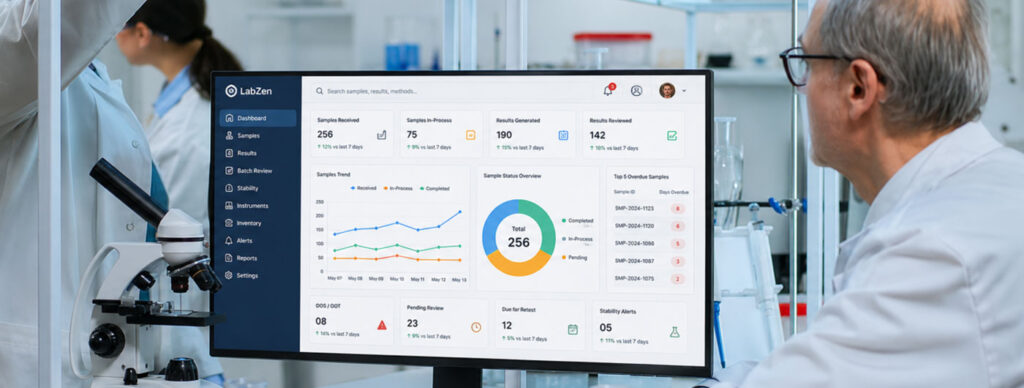
LabZen™, AiZen Algo’s Laboratory Information Management System, is designed to improve laboratory visibility and traceability by providing:
- Centralized sample and test record management
- End-to-end sample lifecycle tracking
- Barcode-enabled sample identification
- Electronic worksheets and reports
- Instrument integration
- Audit trails and electronic signatures
- Real-time dashboards and analytics
- Quick search and retrieval of laboratory records
Final Thoughts
The ability to retrieve laboratory records within minutes is no longer just a convenience—it’s an expectation. Whether responding to an audit, investigating a quality event, or reviewing historical data, quick access to accurate information improves both compliance and operational efficiency.
With a modern LIMS like LabZen™, pharmaceutical laboratories can replace time-consuming searches with instant access to the information that matters most.
Ready to simplify laboratory record management? Discover how LabZen™ helps your QC laboratory improve traceability, streamline operations, and stay inspection-ready.
